
Steep ground in Western North Carolina doesn't stay cleared. It goes back to whatever the seed bank and the birds decide, usually within two seasons of the last cut. Knowing which of the four usual suspects you're fighting tells you what a mowing program can actually accomplish.
The four things you'll fight
Tall fescue is the good news and the bad news. It holds a slope better than anything else you can establish, and it goes to seed and flops over into a mat that hides everything underneath. Left alone for a season it hits three feet; left for two, it's a six-foot tangle with a thatch layer that sheds water instead of absorbing it.
Briar and blackberry arrive next, usually in the disturbed ground along a cut edge or a utility easement. They spread by cane tip and by root, so a mower that cuts them at four inches is pruning them, not killing them. Repeated cutting through a season does eventually exhaust the root crown — but it takes more than one pass.
Kudzu is the one that changes the conversation. In full summer it can put on a foot a day, and it doesn't need soil disturbance to spread. Mowing keeps it off structures and out of sight lines, and it does not remove it. If kudzu is on your property, the honest plan is a multi-year program: cut, treat the crowns, and expect to be at it again.
Then there's the fourth: volunteer trees. Sweetgum, tulip poplar, sumac, and tree-of-heaven come up in the first two seasons after disturbance, and once they're above an inch and a half at the base, a mower stops being the right tool.
Timing beats effort
A cut in late October does more work than two cuts in July. By fall, the plant has already spent its root reserves pushing top growth, and it hasn't yet put energy back down for winter. Cutting before the seed heads mature also removes next spring's seed rain from the equation entirely.
- Cut fescue before it heads out in late spring, then again before the seed matures in early fall.
- Cut briar patches twice, six to eight weeks apart, in the same growing season.
- Cut kudzu early and often — and treat the crowns, or you're just trimming it.
- Cut volunteer trees while they're still under an inch at the base; after that, it's a saw job.
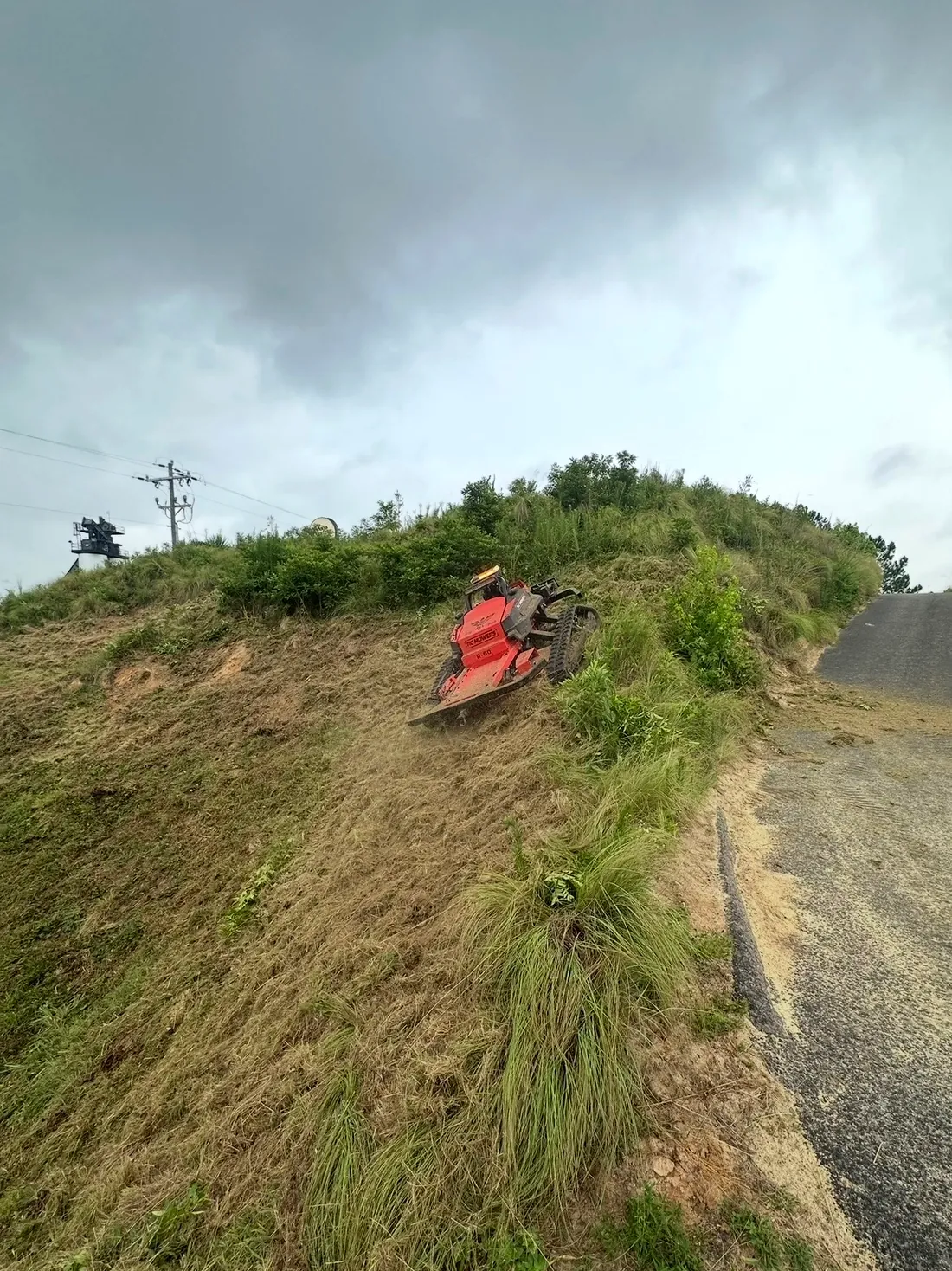
First cut versus maintained slope
A slope that hasn't been touched in two years is a clearing job. Expect a slow pass, a lot of material, and a finish that looks rough because the ground underneath is rough. The second pass, six weeks later, is where it starts looking like a maintained property. By the third, you're on a normal schedule and the cost per pass drops to something you can budget.
That's the argument for putting a neglected bank on a program instead of calling somebody when it gets bad. The expensive version of this work is always the emergency version.
Fire breaks, sight lines, and the other reasons it matters
On rural property, a maintained strip along a fence or a tree line is a fire break whether or not anybody called it that. Along a road, it's sight distance at a driveway. Around a building, it's the difference between a walkable perimeter and a wall of green that hides what's happening at the foundation. None of those show up on a mowing invoice, but they're the reasons the work gets funded.
If you've got a bank that has gone back to the wild, request a free site assessment. We'll tell you whether it's a first-pass clearing, a program, or a job for somebody with a saw and a sprayer.
Written by
Blue Ridge Slope Goat · State Road, North Carolina
We run remote-controlled REAPER mowers on the banks, ditches, and overgrown hillsides crews shouldn't walk. Fully insured, working across Western North Carolina.