
Boone is the highest town of any size in North Carolina, and that one fact reorganizes everything about maintaining ground here. The slope is the obvious problem. The season is the one that costs people money, because it looks long on paper and behaves short in practice.
If you manage property in Watauga County, you already know the bank behind the building is steep. What's harder to hold onto is that the window for getting a machine onto it is maybe half the year, and the window for getting onto it without leaving ruts is narrower still.
The season is shorter than the calendar says
Grass starts moving here in May and stops in October. That reads like six months of mowing. It isn't. The first cut has to wait for the ground to firm up after the spring thaw, which on a north-facing bank can push into late May. By the time the soil is dry enough to hold a machine, the grass is already ahead of you.
Freeze-thaw does the rest. Water gets into the clay, freezes, lifts it, and leaves the surface loose and uneven by March. A heavy machine on that ground in April leaves ruts that become channels, and channels become the erosion complaint you're answering in June. The slope doesn't just make mowing harder. It shrinks the number of days when mowing is the right decision at all.
- Late April: walk the slope and measure the grade before the vegetation hides the surface
- May: first cut, once the ground holds a footprint without sinking
- June and early July: the growth flush, and the cut that actually sets the season
- Late July through August: often dry enough that a cut does more harm than good on a thin bank
- September: the last pass, timed so the bank goes into winter short rather than shaggy
That's five passes in a good year, not the eighteen or twenty a Piedmont lawn gets. Miss two of them and the bank doesn't just look neglected. It changes what's growing on it.
What actually grows on a Boone cut bank
People expect the tall fescue they see on the flat ground in the valley, and that's not what takes over a steep cut at elevation. Old pasture ground here runs to orchard grass, timothy, and white clover. Road cuts come up in crown vetch. The edges fill in with multiflora rose, blackberry, autumn olive, and mountain laurel, and laurel doesn't negotiate.
The practical consequence is that height is not the problem on these banks. Encroachment is. Six inches of orchard grass in June is a mowing job. Two seasons of skipped cuts is a different job, because the rose and the autumn olive have rooted and mowing only sets them back a season. The cheapest cut you will ever do on a Boone bank is the one that keeps it grass.
Who owns the steep ground here
Four kinds of property carry the steep acreage around Boone, and they buy maintenance for four different reasons. Rental cabins and second homes get judged on photographs. Student housing gets judged on whether anybody complains. Commercial pads along US-105 and US-421 get judged from the road, by customers, on the way in. Institutional and county property gets judged by a board that meets monthly and has an insurance renewal in front of it.
The slope is the same on all four. What differs is who has to answer for it, and how long it takes them to notice it's been dropped from the scope.
The three slopes that get skipped
- The bank behind the cabin. It faces away from the driveway and the deck, so it goes unseen until a guest walks the property line or a neighbor mentions it. By then it's September and the season is gone.
- The cut slope behind the commercial pad. It was the site contractor's responsibility during construction and became the tenant's problem at handover, and no one wrote that sentence into the lease.
- The road bank at the property line. Ownership is ambiguous between the parcel and the right-of-way, which is the most reliable way in the world for a slope to go unmowed for four years.
Why a crew on the hill stops making sense
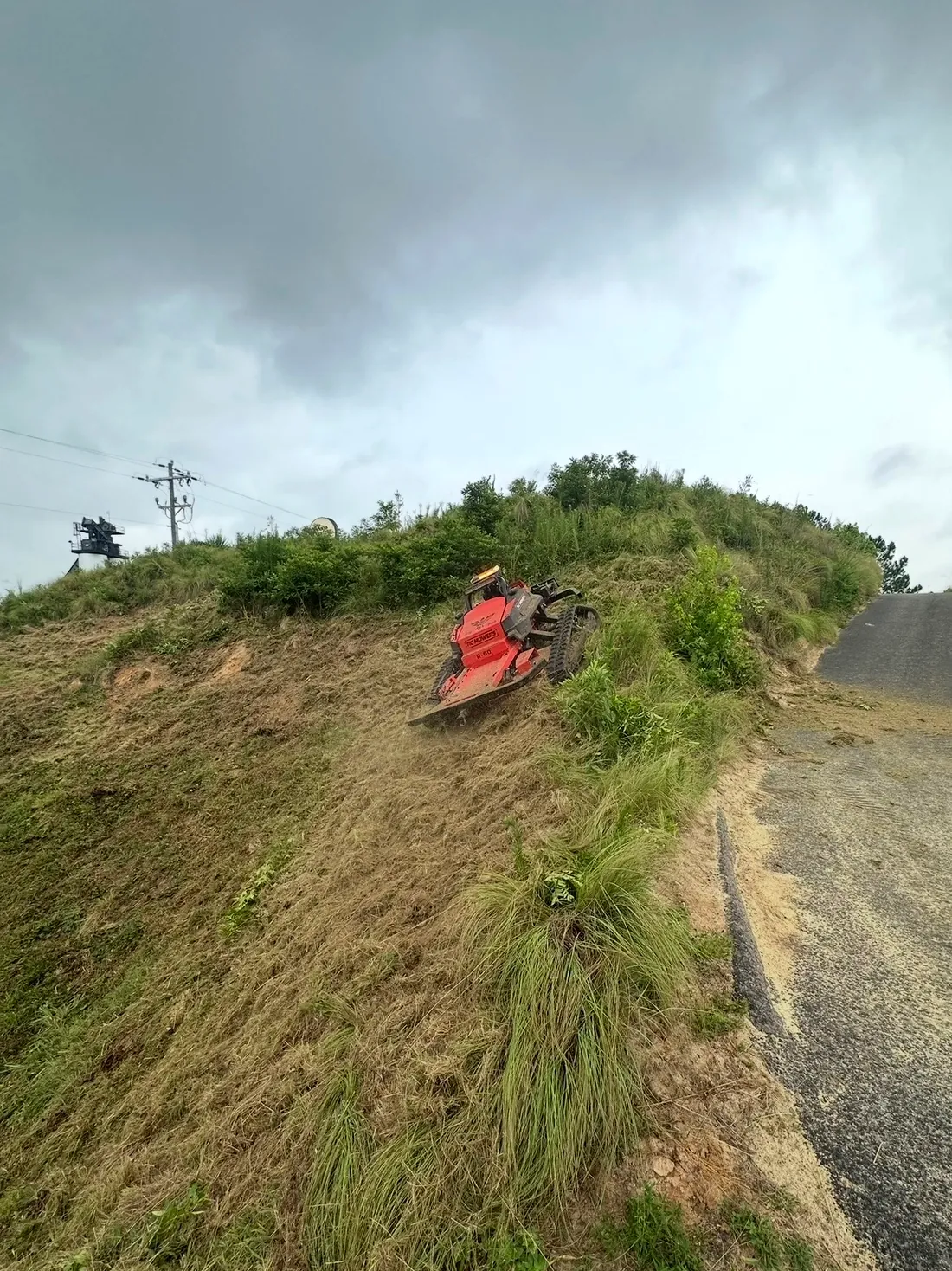
A two-person crew with string trimmers can maintain a 30-degree bank. It just costs what it costs: a full day for ground a machine covers in under an hour, two people standing on a face where a slip is a hospital visit, and a workers' compensation conversation that gets harder every year the slope stays in the scope.
That arithmetic is what eventually pushes the bank out of the contract. Not a decision to stop maintaining it — just a bid that comes back high enough that somebody decides to defer it a season, and then another. A remote machine doesn't make the slope gentle. It takes the person off it, which is the part that was actually expensive.
If you have a bank around Boone that has quietly fallen out of the scope, request a free site assessment. We'll walk it, put the grade in writing, and tell you whether it's a mowing contract, a reclamation job, or ground that should stay wooded. If you want the underlying math first, when a hill stops being a mower job covers the rating numbers and where the honest limit sits.
Written by
Blue Ridge Slope Goat · State Road, North Carolina
We run remote-controlled REAPER mowers on the banks, ditches, and overgrown hillsides crews shouldn't walk. Fully insured, working across Western North Carolina.